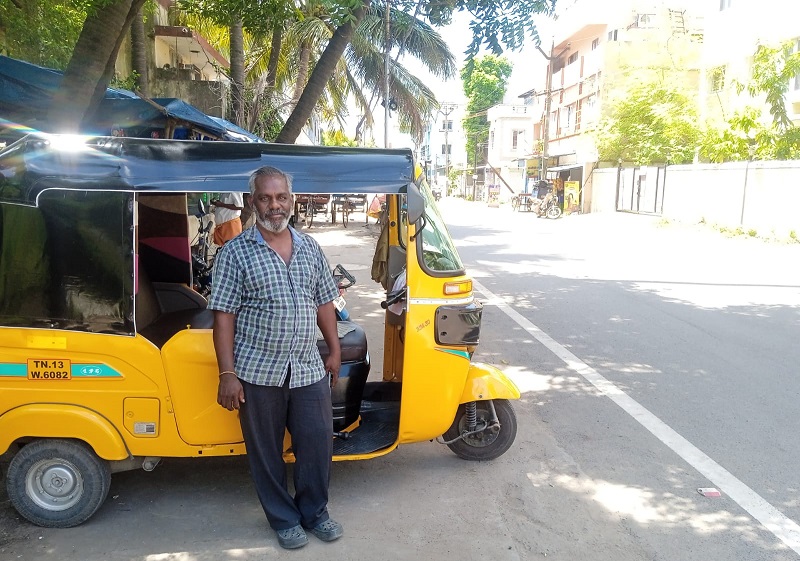

Keeping Us on the Move: A Conversation with Chennai Auto Driver Mr. Kumar
Posted by
Vijay Praveen
June 29, 2026
Public transport plays a vital role in the daily lives of people in Chennai, and auto-rickshaws continue to be one of the most convenient and widely used modes of transport. However, the profession of an auto driver has undergone significant changes in recent years due to rising fuel prices, increasing traffic congestion, and competition from app-based transport services and two-wheeler taxis.
To understand the realities of this profession, I interviewed Mr. Kumar, an auto driver from Chennai who has been working in this field for the past six years. The interview provides insights into the challenges, opportunities, and experiences of an auto driver in today’s changing transport sector.
The interview was conducted in Tamil and recorded as an audio podcast, which has been uploaded to YouTube as supporting evidence.
Interview
Q1. Please introduce yourself and tell us how long you have been working as an auto driver.
Answer: My name is Kumar. I have been working as an auto driver for the past six years.
Q2. What made you choose this profession?
Answer: I was working in a company earlier, but it closed down and I lost my job. I could not find another job, so because of my financial situation and the need to earn an income, I chose this profession.
Q3. What does a typical working day look like for you?
Answer: In a company job, you have to go to work on time and follow strict schedules. But in this kind of profession, I can work with less stress according to my convenience. If someone at home is unwell or there is an emergency, I do not have to seek permission from anyone. This job gives me more freedom and flexibility.
Q4. What are the major challenges you face in your job?
Answer: The price of fuel has increased a lot and traffic congestion has become worse. However, the money we earn has not increased accordingly. These are the issues we face on a daily basis.
Q5. How are rising fuel prices affecting your work?
Answer: Rising fuel prices are the biggest problem I face. They have reduced my earnings drastically. Daily expenses have increased, but the income remains almost the same. It has become difficult to save money and manage household expenses.
Q6. How have app-based services changed your profession?
Answer: App-based rides like Ola, Uber, etc., have affected our livelihood drastically. The entry of two-wheeler taxi services such as Rapido has reduced our business considerably. Nowadays, it is difficult even to earn ₹500 a day.
Q7. What do passengers usually expect from auto drivers?
Answer: It is difficult to say that. Sometimes they are unwilling to even pay the straightforward fare we ask for. All we want is that they pay a fair amount for the services they use.
Q8. What do you enjoy most about your work?
Answer: I enjoy the freedom this profession gives me. I can decide my own working hours and manage my time according to my personal needs.
Q9. What changes would you like to see for the welfare of auto drivers?
Answer: Auto drivers should be faithful to their work, be honest, and drive responsibly. The government should reduce fuel prices and take steps to control the competition from two-wheeler taxi services so that our livelihood is protected.
Q10. What message would you like to share with young people?
Answer: Young people should study well and get good jobs. Those who choose this profession should drive responsibly and be careful. Driving after consuming alcohol is wrong as it puts drivers, passengers, and others on the road at risk. I never allow drunken passengers to create trouble in my vehicle. Safety should always come first. I also hope that the government reduces fuel prices and addresses the challenges faced by auto drivers.
Interviewer: Thank you, Mr. Kumar, for participating in this interview and sharing your experiences.
Mr. Kumar: Thank you, sir.
The interview with Mr. Kumar gives us a glimpse of the everyday struggles and uncertainties faced by such auto drivers in cities and towns where app-based services are popular. Rising fuel costs and heavy traffic are also part of the main concerns for these drivers. Despite these challenges, auto drivers like Mr. Kumar value the freedom and flexibility that auto driving offers compared to regular office jobs. We can see that self-employed workers such as auto drivers are eagerly waiting for government policies and support systems tailored for them. The interview also reflects Mr. Kumar’s concern for passenger safety. Above all, he believes that honesty, hard work, and resilience are essential qualities for any newbie who wants to become an auto kaaran.